16 Japanese Philosophical Movement Concepts
About
The Yu.S.Artistry Method explores contemporary dance through sixteen Japanese philosophical concepts. Rather than focusing only on movement technique, this framework examines the deeper aesthetic and philosophical principles that shape how movement is perceived, embodied, and experienced. Each concept is presented through historical imagery, philosophical interpretation, and contemporary visualization.
AI Visualization
To explore how philosophical ideas can translate into visual movement imagery, an AI visualization project was developed as part of this research.
These images are not intended to replace live performance, but to experiment with how abstract movement qualities and philosophical concepts might be represented visually.
1: Yugen (幽玄)
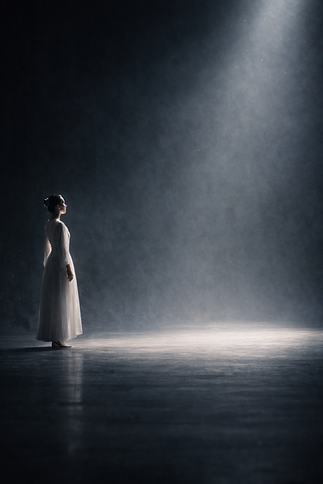
Yūgen refers to a subtle and profound beauty that lies beyond direct visibility. It is an aesthetic that moves the heart through suggestion, atmosphere, and emotional resonance rather than explicit expression.
In dance, Yūgen appears when movement suggests meaning rather than clearly defining it. Instead of strictly following formalized structures, the dancer allows the atmosphere and emotional depth behind the movement to emerge, inviting the audience’s imagination to complete what cannot be fully shown.


2: Ma(間)
Ma refers to the aesthetic of space, pause, and timing — the beauty that exists between actions, sounds, or gestures.
In dance, Ma appears through moments of stillness or pauses between movements.
These intervals deepen meaning and create contrast, allowing emotion, tension, and atmosphere to resonate more strongly.

3: Jo-Ha-Kyū(序破急)
Jo-Ha-Kyū is a structural principle describing the natural progression of events: a beginning (Jo), a development or break (Ha), and a rapid conclusion (Kyū).
In dance, Jo-Ha-Kyū appears through the gradual transformation of movement.
By shifting the speed, intensity, or scale of motion, the dancer builds tension and release, creating rhythm and dynamic flow within the choreography.


4: Zanshin(残心)
Zanshin refers to a state of continued awareness and presence that remains even after an action has ended.
It originates in Zen and martial arts philosophy and emphasizes sustained attention beyond the completion of movement.
In dance, Zanshin appears when the dancer maintains awareness and intention even after a movement finishes.
This lingering presence creates resonance, allowing the performance to feel complete while sustaining tension and focus.

5: Engi(縁起)
Engi refers to the Buddhist concept of interdependence — the idea that all phenomena arise through relationships, connections, and mutual influence.
In dance, Engi appears through awareness of relational movement.
By considering how movement interacts with space, other dancers, and the audience, choreography becomes a dynamic network of relationships rather than isolated actions.


6: Ryūdōbi(流動美)
The beauty of flow and transformation — movement that exists in continuous change rather than fixed form.
A movement principle based on the concept of flow.
By moving with the awareness of a fish swimming through the body, the dancer connects each motion seamlessly, maintaining internal continuity.

7: In-Yō(陰陽)
The ancient Chinese concept of duality — the coexistence of light and dark, active and passive, visible and hidden forces.
A movement principle based on contrast.
Like Yin and Yang, it reflects the relationship between visible energy (on) and invisible rest (off).
By bringing this awareness into the joints and body structure, true isolation emerges through conscious contrast.


8: Fūshi(風姿)
Refined appearance — the outward grace that naturally reflects inner cultivation.
A principle related to the origin of extension.
Like classical ballet, the dancer projects energy outward, creating refined body lines and spatial harmony.

9: Ruten(流転)
The concept of constant transformation — the idea that all forms exist in flux and are continuously changing.
A principle related to release technique and fall-and-recovery.
The dancer connects the downward energy of release to the next movement, embodying continuity, transformation, and renewal.


10: Mizu no Nagare(水の流れ)
The flow of water — natural, effortless movement that follows gravity and momentum.
A principle related to the origin of floorwork.
Through weight shifts, rhythmic contrast similar to In-Yō, and horizontal momentum, the dancer creates continuous movement even while traveling across the floor.
11: Aimai-bi(曖昧美)
The beauty of ambiguity — valuing suggestion, nuance, and subtle interpretation rather than explicit clarity.
A principle related to the use of gesture in choreography.
By first establishing recognizable gestures and then gradually abstracting or blurring them, movement evolves into a more nuanced and dance-oriented expression.


12: Ki(気)
The vital energy that connects body, mind, and environment.
By consciously engaging with the breath, the dancer strengthens the connection between body and mind, allowing movement to become integrated, expressive, and internally connected.
13: Mu-i Shizen(無為自然)
“Non-action” and naturalness — acting in harmony with nature without force or artificial intention.
By abandoning fixed forms and embracing a natural state, the dancer becomes aware of gravity and develops grounded movement, in contrast to the upward orientation often emphasized in ballet.


14: Kyōka Suigetsu(鏡花水月)
“Flowers in the mirror, moon in the water” — a metaphor describing the beauty of illusion, reflection, and transience.
Rather than simply reproducing choreography, the dancer interprets the choreographer’s intention and adds personal nuance, transforming imitation into living expression.

15: Shiki Soku Ze Kū(色即是空)
“Form is emptiness, emptiness is form” — a Buddhist concept expressing the interdependent and impermanent nature of all phenomena.
Like Engi, this concept encourages dancers to perceive space and existence multidimensionally.
By embodying other forms—such as wind, trees, or stones—the dancer dissolves the boundary between self and environment, creating a unified stage image.


16: Shin-Gyō-Sō(真行草)
The three modes of expression: formal (Shin), semi-formal (Gyō), and cursive or free (Sō).
Dancers shift consciously among three layers of awareness: visible form, internal expression, and animistic consciousness.
Through these transitions, performance gains contrast, depth, and expressive range.